Gheg and Tosk
Every page on this site teaches Standard Albanian — the form standardized at the 1972 Congress of Orthography in Tirana, based mainly on the Tosk dialect spoken in the south of the country. Kosovo's own Albanians, who natively speak Gheg, had already adopted this same Tosk-based standard for writing and education four years earlier, at the 1968 Linguistic Conference of Pristina — which is why the grammar on this site holds everywhere Albanian is written or taught, even in places where the everyday spoken language is Gheg.
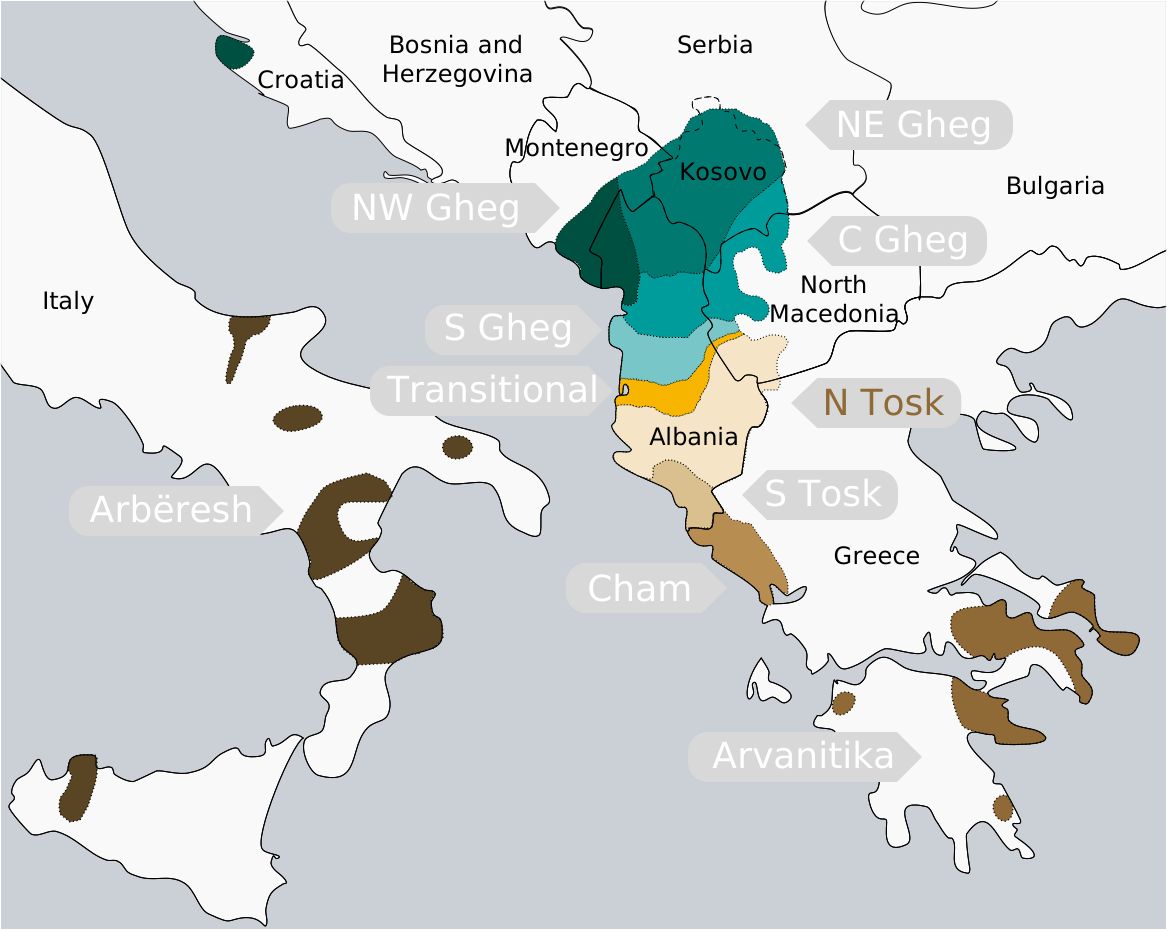 Map: Gheg- and Tosk-speaking areas, based on Gjinari (1988) and Elsie & Gross (2009). © Stefano Coretta, Júlio Reis, CC BY-SA 4.0, via Wikimedia Commons. The real picture has more nuance than the simple two-way split discussed below — note the separate Transitional zone, and the Arbëresh/Arvanitika/Cham communities in Italy and Greece.
Albanian is traditionally split into two main dialect groups along the Shkumbin river: Gheg to the north, and Tosk to the south. Gheg isn't a simplified or "incorrect" form of Albanian — it's a full dialect in its own right, spoken natively by millions of people (most of Kosovo, northern Albania, and Albanian communities in North Macedonia and Montenegro), and it's actually the more conservative of the two branches in several ways: it kept some older sounds and forms that Tosk went on to lose or change. This page isn't a Gheg course — it just names the main differences so you're not confused if you encounter Gheg forms elsewhere.
Nasal vowels
Common Albanian originally had nasal vowels. Gheg still has them; Tosk lost them, so the same historical vowel comes out as a plain (oral) one in the standard language:
Meaning | Standard (Tosk-based) | Gheg |
nine | nëntë | nandë |
voice | zë | zâ |
thing | gjë | gjâ |
Rhotacism (n → r)
At some point during the Middle Ages, an old "n" sound between two vowels turned into "r" in Tosk — a change linguists call rhotacism. Gheg never underwent it, so it kept the original "n":
Meaning | Standard (Tosk-based) | Gheg |
wine | verë | venë |
the city of Vlorë | Vlorë | Vlonë |
The infinitive
This is the difference every learner runs into first. Standard Albanian has no true infinitive — where English uses "to" + a verb, Standard Albanian uses the subjunctive ("të" + a conjugated verb) instead. Gheg, however, kept a real infinitive: the particle "me" followed by a participle.
Meaning | Standard (subjunctive) | Gheg (true infinitive) |
I want to work | Dua të punoj | Dua me punu |
It's time to sleep | Është koha të flemë | Është koha me fjetë |
Every "Albanian has no infinitive" claim made elsewhere on this site refers specifically to Standard Albanian. If you ever come across a Gheg sentence built with "me" + a participle where this site would use "të" + a subjunctive, that's the reason — it's a different, equally valid dialect making a different, older choice, not a mistake.